


Beyond the Backyard Braai: Why PPPs are KZN’s Secret to World-Class Growth

Everyone knows the secret to a great braai is the right equipment and a master chef. We’re applying that same logic to KZN’s infrastructure to ensure security, efficiency, and real accountability.
It is a challenge every time you're at the market or a networking event—you share a vision for growth, and the "But Brigade" immediately starts building walls. When it comes to the Public-Private Partnership (PPP) model, people often think it's just a fancy way for the government to ask for money, but it’s actually a highly sophisticated security and efficiency mechanism.
To win over the skeptics, we can frame the PPP as a "shared skin in the game" strategy. Here is a breakdown of how it works in layman's terms for your article.
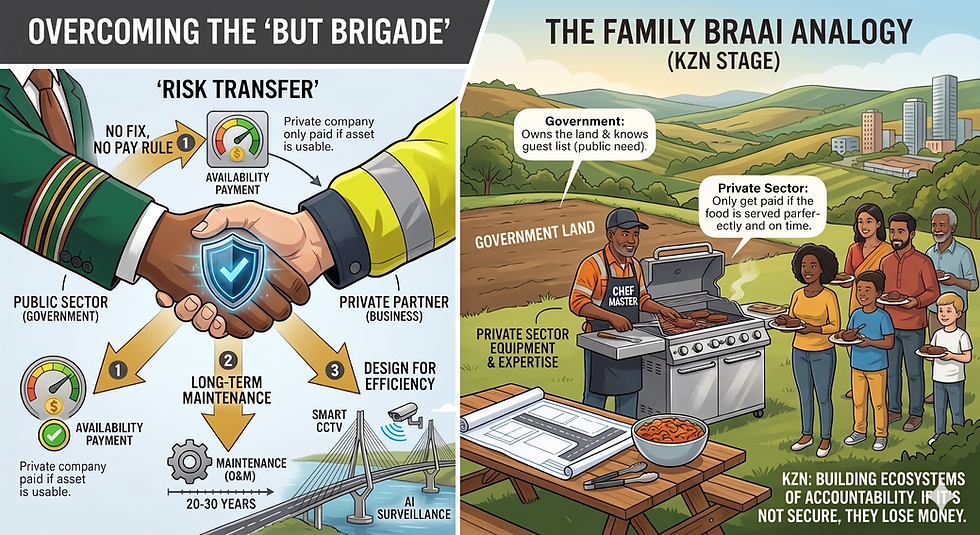
The "Family Braai" Analogy
Think of a massive infrastructure project like a neighborhood braai.
The Public Sector (Government): Owns the land and has the guest list (the public need). They provide the "yard."
The Private Sector (Business): Brings the high-end grill, the secret spice rub, and the master chef. They provide the "expertise and equipment."
In the old way of doing things, the government would try to buy the grill and cook the meat themselves, often leading to a long wait and burnt chops. In a PPP, the private sector manages the cooking and maintenance, and they only get paid if the food is served perfectly and on time.
How it
Addresses the "Buts" (Security & Risk)
The genius of the PPP isn't just about the money; it’s about Risk Transfer. This is the ultimate answer to the "What about security?" question.
1. The "No Fix, No Pay" Rule
In a standard government contract, if a bridge gets vandalized or a site is insecure, the taxpayer often foots the bill for repairs. In a PPP, the private partner is usually responsible for the O&M (Operations and Maintenance) for 20 or 30 years. If the infrastructure isn't usable because of security issues, the private company doesn't get their "availability payment" from the government.
The Takeaway: Security becomes a business priority, not just a line item. The private sector must keep the asset safe to protect their investment.
2. Efficiency by Design
Private companies design the project with long-term costs in mind. They won't just build a fence; they’ll integrate smart technology, AI-driven surveillance, and rapid response because it’s cheaper to prevent a problem than to fix a broken asset for three decades.
3. Clear Accountability
In a PPP, the roles are legally locked:
Government: Sets the standards (e.g., "This road must be safe for 24-hour travel").
Private Partner: Decides how to meet those standards (e.g., "We will install high-spec lighting and 24/7 patrols").
Why KZN is the Perfect Stage
For the developments you’re seeing in Shongweni and across the province, these partnerships allow for World-Class Standards on Local Soil.
By using the PPP model, we aren't just building buildings; we are building Ecosystems of Accountability. The "Buts" regarding security are answered by the fact that the private sector’s profit is directly tied to the safety and functionality of the project. If it’s not secure, they lose money. There is no better incentive for excellence than that.
The "Roving Reporter"
Best for short, punchy updates about weekly wins.
Grant Adlam | KZN Top Business "The KZN Convergence"
Bringing you the hard facts from the corridors of the KwaZulu-Natal economy.
Stay Connected: 🌐 www.kzntopbusiness.co.za ✉️ info@topbusiness.co.za 📺 Watch the latest Business Sense updates on YouTube > #KZNTopBusiness #RovingReporter #SuccessBreedsSuccess #KZNEconomy


