


AGENTIC AI: THE NEXT FRONTIER IN AUTOMATION

Businesses today manage complex operations while receiving vast amounts of data from operations, customers and suppliers, making it difficult to analyse information quickly. With Agentic AI, regular tasks can be automated and the AI system adjusts rapidly to new circumstances. By enabling faster data-driven actions, it reduces reliance on human input. This frees teams to focus on critical work and respond better to market shifts.
Agentic AI refers to artificial intelligence systems that possess agency, meaning they can act autonomously to achieve goals or perform tasks without constant human intervention. These AI systems are capable of making decisions, planning and executing actions in dynamic environments, often adapting to new information or changes.
Agentic AI is emerging as the next frontier in automation, addressing limitations in Robotic Process Automation (RPA) and unstructured data processing by enabling cognitive capabilities and dynamic decision-making for complex tasks. Agentic AI is designed to operate with a degree of independence, simulating aspects of human-like agency in problem-solving and decision making processes as well as enhancing task execution and reduction of errors.
Over the past decade, Robotic Process Automation (RPA) has evolved from simple task based tools into sophisticated hyper-automation platforms. These platforms integrate various AI services to meet diverse cognitive demands for end-to-end automation. However, real-world applications often fall short, with automation covering only 30% to 40% of processes, mainly targeting rule-based tasks. This limitation stems from several factors namely lengthy and costly AI service implementation, dependence on training data and evolving business process steps. Agentic AI addresses these limitations by processing unstructured data and enabling dynamic decision-making. It can independently perform tasks, use tools and respond to feedback.
Unlike GenAI, which offers insights, Agentic AI applies reasoning to achieve goals and execute actions, delivering measurable outcomes. Through cognitive automation, it strengthens business process optimisation and intelligent process automation. Agentic AI can significantly enhance business performance and competitiveness in the current environment. In the current fast paced and data rich business environment, Agentic AI enables organisations to be more agile, customer-centric and resilient. It supports strategic goals by augmenting human capabilities and automating decision-intensive processes through the following:
■ Improved decision making: Agentic AI can analyse vast amounts of data, identify patterns, and make informed decisions quickly
■ Automation of complex tasks: Agentic AI can handle complex, dynamic tasks that require judgment and adaptation
■ Personalisation at scale: It can autonomously tailor products, services, and communications to individual customer preferences and improving customer experience
■ Operational efficiency: By autonomously managing workflows, optimising resource allocation and predicting maintenance needs, Agentic AI reduces costs and increases productivity
■ Innovation enablement: Agentic AI can explore new business models, simulate scenarios and generate creative solutions, helping companiesinnovate faster and more effectively
■ Risk management: It can proactively identify and mitigate risks by continuously monitoring internal and external factors, enhancing compliance and security
■ Enhanced collaboration: Agentic AI can act as an intelligent assistant, facilitating collaboration across teams by managing information flow, scheduling, and decision support
Building a Risk Framework for Agentic AI
As organisations adopt Agentic AI, autonomous, real-time decision-making, the need for a robust risk management framework becomes vital. These systems respond dynamically to changing environments, making decisions and taking actions independently. While the potential is immense, so are the risks ranging from unpredictable behavior to ethical breaches and compliance failures.
To manage these effectively, organisations must go beyond static safeguards and adopt dynamic oversight, continuous monitoring, and adaptive governance. A comprehensive AI Risk Framework embeds long term controls, enabling a culture of responsible AI use. It helps prevent unintended consequences, whether from system failures or human misuse and is crucial in regulated, data-sensitive sectors. Without this foundation, organisations risk not only operational disruption but also reputational and regulatory fallout.
EY as a Foundation
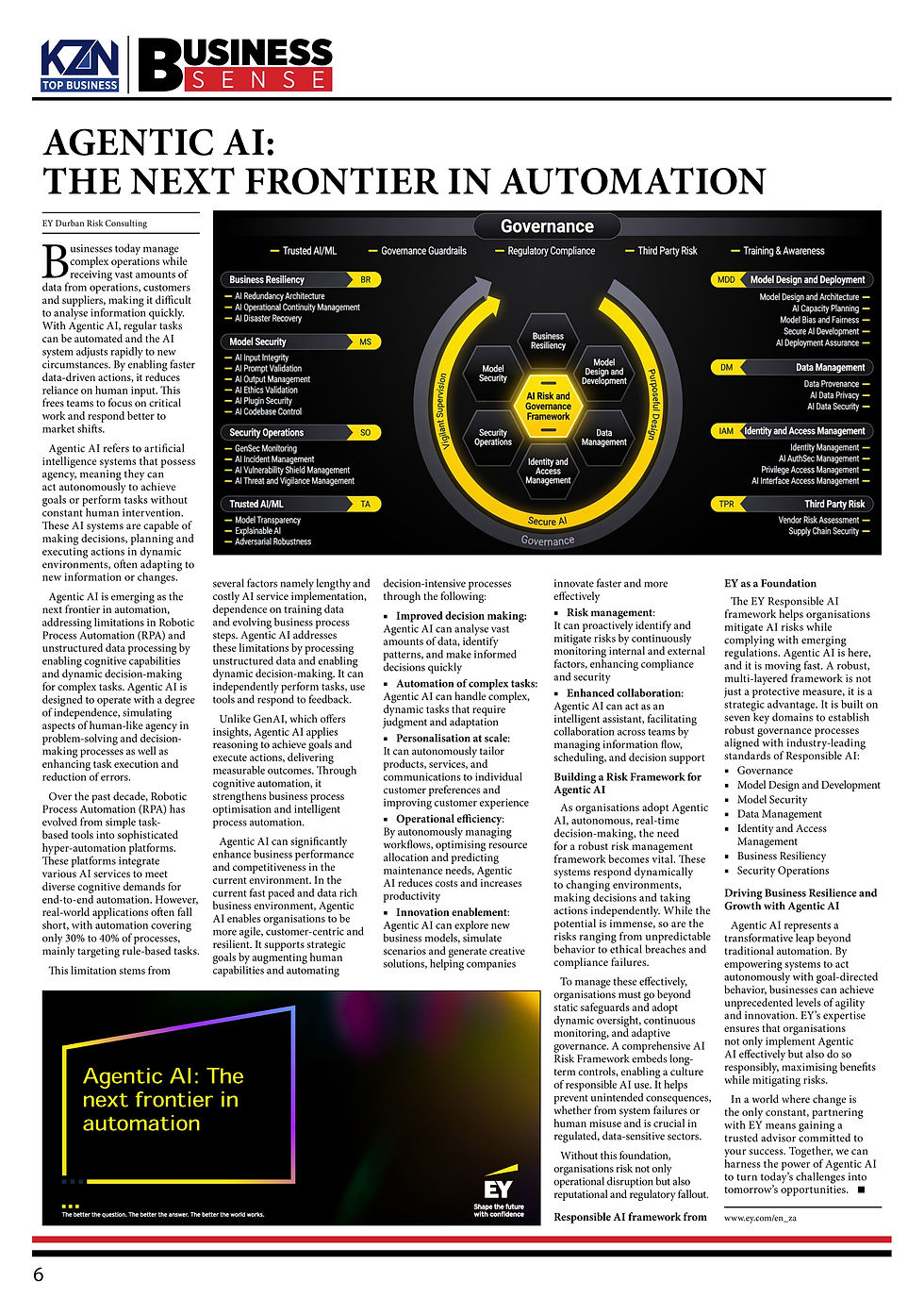
The EY Responsible AI framework helps organisations mitigate AI risks while complying with emerging regulations. Agentic AI is here, and it is moving fast. A robust, multi-layered framework is not just a protective measure, it is a strategic advantage.
It is built on seven key domains to establish robust governance processes aligned with industry-leading standards of Responsible AI:
■ Governance
■ Model Design and Development
■ Model Security
■ Data Management
■ Identity and Access Management
■ Business Resiliency
■ Security Operations
Email: www.ey.com/en_za


 |  |  |
 |  |  |
 |  |  |
 |  |  |
 |  |  |


