KZN’S PROPERTY PLOT TWIST

Updated: May 14
Heather Flack, Business Leader, Flair Accounting
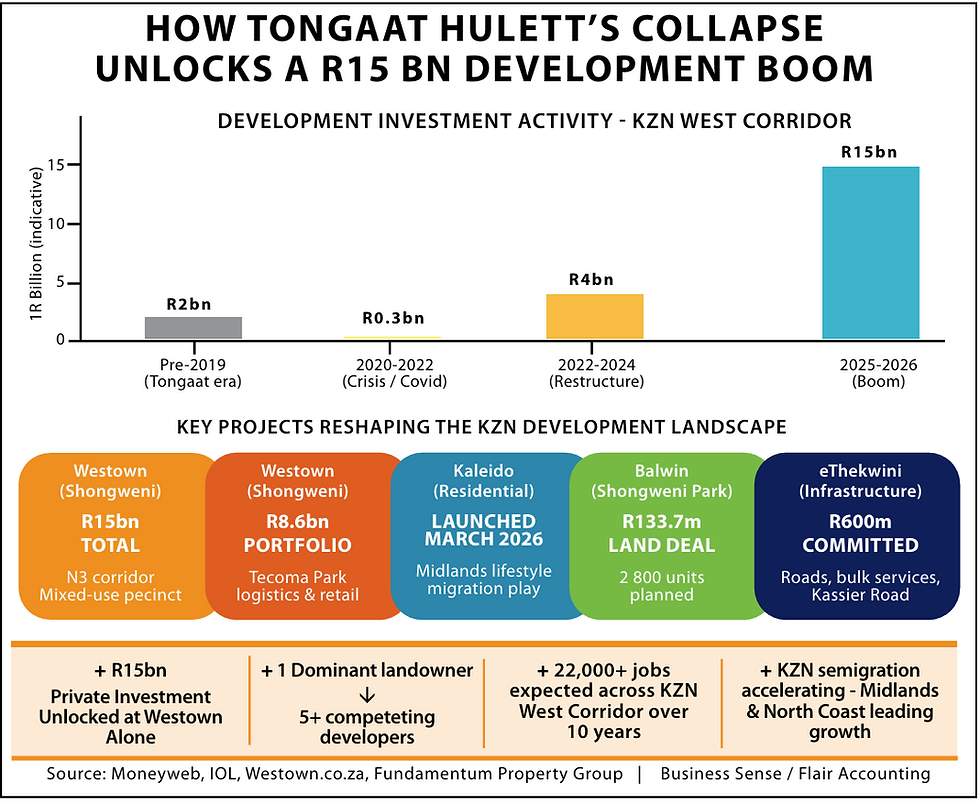
Out of one of the province’s most painful corporate collapses, an unexpected R15 billion development boom is taking shape.
There is a version of this story that begins with winners and opportunities. We’ll get there. But the honest version starts with something harder.
Tongaat Hulett was once one of KwaZulu-Natal’s great employers. For generations of workers across the province – in its sugar mills, on its farms, in its property and development divisions – it represented stable livelihoods and community. At its peak, the group directly and indirectly supported tens of thousands of jobs across KZN. When its governance collapsed under the weight of an accounting scandal, compounded by Covid and the July 2021 unrest, the consequences were not just felt in boardrooms and on JSE screens. They were felt in households.
That context matters. Any honest assessment of what is now happening in KZN’s property market has to begin by acknowledging that the opportunity before us emerged from real hardship. It does not diminish the new chapter to say so. If anything, it makes what is unfolding more meaningful: a province using the wreckage of one era to build something better.
The Setup: One Company, 8 200 Hectares, and a Difficult Decade
For decades, Tongaat Hulett held an extraordinary position in KZN’s development landscape. The group controlled approximately 8 200 developable hectares across the province – stretching from Umhlanga’s coastal corridor through the airport precinct, along the North Coast, and deep into the Outer West via the Shongweni basin. That’s not just land. That’s leverage over an entire province’s urban growth trajectory.
The collapse of that structure – through governance failures, the disruption of Covid, and the destruction of the 2021 unrest – forced something the market would never have produced on its own: the land had to be sold, and sold at pace. Where one company’s vision and financial capacity had previously determined the tempo of development across these nodes, suddenly multiple well-capitalised developers were moving simultaneously, in competition, with their own capital and their own timelines.
Jan Jansen van Vuuren, development manager at Fundamentum Property Group, describes it plainly: “It forced them to sell. What happened subsequently? Half the land was sold to developers with the right capital. Instead of one developer, you have four, five or six as big balance sheets drive development at a bigger pace. It’s actually a good thing in the longer run.”
What Is Being Built — And Where
The most visible expression of this momentum is Westown, the R15 billion mixed-use precinct taking shape in Shongweni, just off the N3 near Hillcrest. The March 2025 opening of Westown Square – a 50 000m² high-street retail hub – was followed weeks ago by the March 2026 launch of Kaleido, a residential precinct designed to capture KZN’s growing semigration market. Where this corridor had almost no economic development activity for a decade, it is now the most active property node in the province.
South Africa’s largest JSE-listed REIT, Growthpoint Properties, has committed R8.6 billion across 560 000m² of KZN assets – including the R392 million Tecoma Park logistics hub on the N3 corridor.
Balwin Properties has concluded a R133.7 million land deal for 2 800 residential units in the same node. Collins Residential and Devmco are replicating a similar “managed cluster” approach across the province’s coastal and midlands corridors. Developers are calling the N3 corridor between Durban and Pietermaritzburg “the Midrand of KZN”. That comparison is not casual: it references the scale of transformation that Waterfall City achieved in Gauteng, and suggests a similar institutional confidence in the long-term trajectory of this part of the province.
What This Means for Your Business – Right Now
Development announcements are easy to read as news for other people – for property investors, for large corporates, for people who build things. But the structural shift underway in KZN creates specific, tangible opportunities for businesses of every size operating in this province. Here is where to look.
Professional services have an early-mover window. Every new precinct– residential, commercial, or mixed-use – generates demand for accountants, attorneys, financial advisers, HR consultants, payroll services, and IT support from the businesses that move into it. If your professional services firm is not already visible in the Hillcrest, Outer West, and N3 corridor catchment, this is the moment to consider it.
The construction and fitout supply chain is running hot. Westown alone requires R900 million in bulk infrastructure, and that is before a single building interior is finished. Electrical contractors, plumbers, tilers, furniture suppliers, signage companies, landscapers, and security installers are all in demand across multiple simultaneous project sites. For any KZN trade or supply business, the question is whether you are registered with the procurement systems of the major developers. If not, that registration conversation is worth having now.
Retail and hospitality have a semigration tailwind. The households relocating from Gauteng to KZN’s coastal and midlands corridors are bringing spending power with them. They need restaurants, coffee shops, specialist food retailers, gyms, medical practices, schools, and lifestyle services – and they are clustering in exactly the nodes where the new development activity is concentrated. Kaleido’s residential launch is a direct bet on this demographic. For KZN hospitality and retail operators, these new residential precincts represent a fresh audience.
Logistics and warehousing demand is rising along the N3. The Tecoma Park logistics hub and the broader industrial belt forming along the N3 corridor represent a genuine shift in how freight moves through the province. For businesses dependent on supply chains – manufacturers, distributors, importers, and exporters – proximity to institutional-grade warehousing adjacent to the highway network is increasingly a competitive differentiator. If you are approaching a lease renewal decision, the N3 industrial corridor is worth benchmarking against your current address.
A Forward-Looking Note
KZN still has genuine challenges. Municipal capacity, infrastructure backlogs, and the lingering economic effects of the 2021 unrest are not resolved by a few property announcements. Many of the communities most affected by Tongaat Hulett’s collapse are still navigating that transition. These realities deserve to be named.
What is also true is that the property market is not waiting for those challenges to be fully resolved before it moves. The managed-precinct model is, in part, a pragmatic response to exactly those constraints – private capital stepping into the maintenance and governance role that public institutions cannot currently fill. It is not a permanent solution to KZN’s structural challenges. But it is creating real activity, real jobs in construction and operations, and real opportunities for businesses that are paying attention.
The R15 billion arriving in Shongweni, the R8.6 billion institutional bet from Growthpoint, the Balwin and Devmco clusters spreading across the coastal and midlands corridors – these are not on a planning board. The shovels are in the ground. For KZN business owners, the question is less whether this is happening and more what they intend to do with it.
"Instead of one developer, you now have four, five or six with the right capital driving development at a bigger pace. It’s actually a good thing in the longer run." – Jan Jansen van Vuuren, Fundamentum Property Group

 |  |  |
 |  |  |
 |  |  |
 |  |  |
 |  |  |