


A WELL-ROUNDED, SOLID CHINESE WORKHORSE

Updated: Sep 3
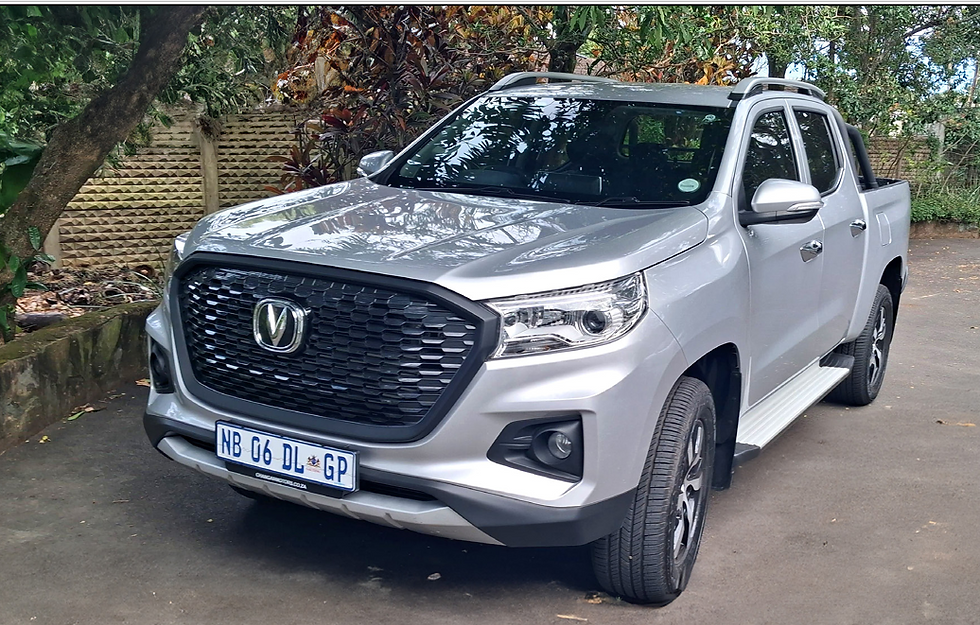
The Changan Hunter K50 REEV is a fantastic vehicle; it looks like Changan has realised that the commercial sector wants an affordable, workhorse bakkie that runs on diesel. Diesel is the standard for getting work done, with strong torque and a longer range than petrol vehicles. While currently not in this climate, historically diesel has been the cheaper fuel.
These factors have made diesel bakkies the standard in the commercial sector. Catering to both markets, it seems that Changan also decided to release their new Hunter 2.0D for South Africa, cutting back on looks and features but doubling down on utility. Surprisingly, however, this bakkie has a French side…
What is badge engineering?
Badge engineering is essentially when an automaker sells a vehicle from another automaker and rebrands it as their own, sometimes adding certain cosmetic details or trims to distinguish the vehicles from one another. These cars are usually a result of a partnership between the two manufacturers, agreeing to share vehicle platforms or manufacturing plants. An example in South Africa is the Toyota and Suzuki partnership, where cars like the Suzuki Baleno and Toyota Starlet are essentially the same car, built in the same factory, with very minor cosmetic differences. For the Changan Hunter 2.0D, it is essentially a badge engineered Peugeot Landtrek, with minor differences in trims and design.
Engineering and Specifications
The bakkie features a 2.0l diesel engine that delivers 110kW of power, at 350nm of torque. This diesel engine is paired to an automatic transmission and utilises an AWD system, however, you can pair the Hunter with a manual, but this only utilises 2WD. In our testing, the bakkie was surprisingly capable, offering a smooth ride and an ample amount of power. Technology-wise, due to the utilitarian nature of the vehicle, technology is toned down compared to the K50 REEV.
Whilst the bakkie does not include CarPlay or Android Auto, it does feature Bluetooth which I personally think is enough for me (Yes, the Spotify sessions are indeed important). A touchscreen is still present, and controls are still on the steering wheel as well for ease of use. We also got physical air-conditioning controls which are always nice to see. As for the usual tech, the bakkie comes with four airbags, ABS and EBD as standard, reverse parking sensors and camera, and electronically controlled seating for our trim according to Cars.co.za.
Design and Interior
The exterior design of this car is overall quite good. Essentially, the front looks like it’s made to look like a capable off-roader and utility truck, without trying to look too aggressive. The interior offers good leg and head room for front and rear passengers as well as comfortable seating.
Space and Utility
Changan claims that the Hunter has a payload capacity of 1000Kg for the truck bed for our variant and 1100Kg for the manual, 2WD variant. With a 28-degree approach angle and 226mm of ground clearance, the Changan proves more than capable of tackling more rough terrain.
Price and Overall Thoughts
Pricing for the Changan Hunter 2.0D starts at R449,900, with our automatic variant starting at R569,900. Our variant is placed right near the Landtrek ACTIVE DCAB 4x4 MT, however as the name suggests, the Peugeot is a manual. In my opinion, while more competitively priced bakkies exist in the market, the Changan holds its own. It’s a well-rounded package: good build quality, decent engine, generous truck bed at an overall decent price. Let’s not forget the manual version, at R449,900 for a double cab is very good, even if it is 2WD. As such, I believe the Changan Hunter 2.0D is a solid utility focused bakkie that excels in many of its aspects.

 |  |  |
 |  |  |
 |  |  |
 |  |  |
 |  |  |

